Climate unpredictability in South Sudan: a growing threat
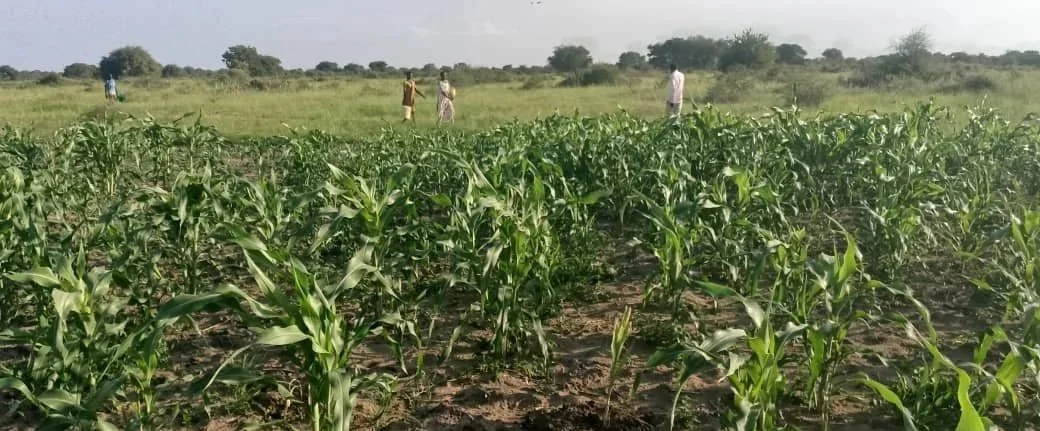
Part of the peace farms in the Greater Bor area
Climate change is no longer a distant environmental concern; it is a daily reality for communities across South Sudan. Its effects are becoming increasingly visible, particularly in the agricultural sector, where changing weather patterns are threatening food production and the livelihoods of millions of people.
Agriculture is the backbone of South Sudan's economy, and the majority of farmers depend on rain-fed farming. Unlike irrigated agriculture, rain-fed farming relies entirely on natural rainfall to provide the soil moisture needed for crop growth. This makes farming communities highly vulnerable to changes in weather patterns.
In 2026, farmers in the Peace Farms supported by POF in Lakes, Jonglei, and GPAA prepared their land on time, expecting the rainy season to begin as usual. However, the main challenge was not a lack of rainfall but its increasingly unpredictable timing. The delayed and irregular onset of the rains disrupted planting schedules, reduced crop yields, and heightened the risk of crop failure, leaving many farming households facing greater uncertainty over food security and income.
The increasing frequency of delayed rainfall and erratic weather patterns highlights the urgent need to strengthen South Sudan's resilience to climate variation. Scientific studies show that rainfall has become increasingly variable, while climate-related shocks including floods, delayed rainy seasons, and prolonged dry spells are disrupting agriculture, threatening food security, and undermining livelihoods. With around 80% of the population dependent on climate-sensitive livelihoods, investing in climate adaptation and resilient agricultural systems has become an urgent national priority (World Bank, 2026, 10-11).
At the same time, expanding access to innovative agricultural technologies is essential to reducing farmers' dependence on increasingly unpredictable rainfall. Solutions such as solar-powered irrigation systems, drip irrigation, and water harvesting technologies can provide more reliable sources of water during dry periods, improve crop yields, and strengthen resilience to climate-related shocks.
While irrigation remains limited in South Sudan, small-scale irrigation initiatives have demonstrated promising results in some communities, particularly where farmers have access to shallow groundwater, rivers, or seasonal water sources. Solar-powered irrigation has shown potential because it reduces the high operating costs associated with diesel pumps and can be used in remote areas with limited access to electricity. However, scaling up these approaches will require significant investment in rural infrastructure, affordable financing for farmers, reliable supply chains for equipment and spare parts, technical training on installation and maintenance, and stronger extension services to support adoption. Investments in community-managed water harvesting systems, small reservoirs, and farmer cooperatives could also help improve the sustainability and affordability of irrigation. When combined with climate-smart farming practices and supportive government policies, these technologies have the potential to significantly increase agricultural productivity, improve food security, and build resilience to the growing impacts of climate change.
Building a climate-resilient agricultural sector requires coordinated investment from the government, development partners, the private sector, and local communities. By improving climate information services and promoting modern irrigation technologies, South Sudan can protect farmers' livelihoods, enhance food security, and create a more sustainable agricultural future.
Drafted with the assistance of AI.