
When the Chiefs Stayed After Dark: Reviving Murle Leadership for Peace in Pibor
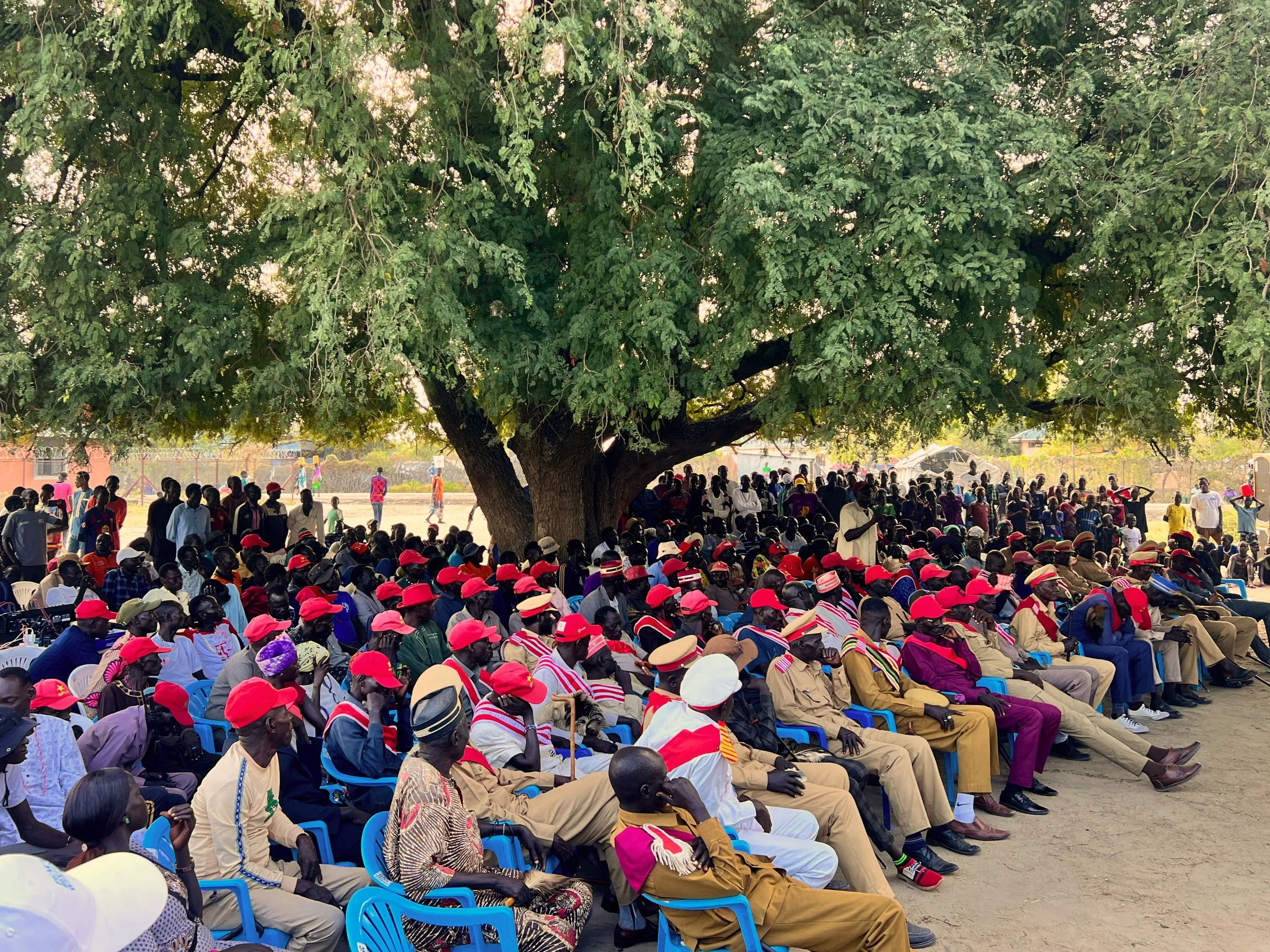
In December 2025, something rare happened in Pibor Town. For the first time since the 1990s, Murle chiefs from across the Greater Pibor Administrative Area (GPAA) gathered in one place—not in response to a single crisis, but to collectively confront the deeper patterns driving insecurity in their communities.
The GPAA Chiefs’ Peace Conference was initiated by the Office of the Chief Administrator, reflecting a clear call from within Murle communities themselves: traditional authorities needed a unified platform to restore customary law, confront cattle raiding and child abduction, and reassert leadership over a generation of militarised youth. Peace Canal, with support from the Peacebuilding Opportunities Fund (POF), accompanied this locally driven effort from 10–13 December 2025 .
VLOG summary of the conference
Why this gathering mattered
GPAA continues to face chronic violence linked to cattle raiding, child abduction, inter-age-set fighting, and cross-border tensions with neighbouring communities. While chiefs remain trusted figures, their authority has been eroded over time—fragmented by conflict, under-resourced, and disconnected from formal governance systems.
The conference was designed to address that gap directly: bringing together paramount chiefs, executive chiefs, spiritual leaders (Red Chiefs), commissioners, women and youth representatives, and state officials to harmonise Murle customary laws, align with the Local Government Act, and translate past peace resolutions into practical action. Crucially, it was not framed as an externally driven “peace event”, but as a Murle leadership conference—owned, shaped, and led from within GPAA.
What happened in Pibor
Over three days, the conference tackled some of the most sensitive and contested issues facing GPAA. Murle customary laws were reviewed, revised, and endorsed— including the formal incorporation of provisions addressing child abduction, a significant step given the political and social weight of the issue. Chiefs, commissioners, and senior judicial figures jointly emphasised that laws only matter if they are implemented, and that failure by chiefs to enforce them must carry consequences.
Border security featured prominently. While there was consensus that government bears responsibility for securing borders—including, where necessary, the use of force—chiefs also reaffirmed their role in discouraging violence, sharing information, and preventing escalation at community level. The conference also revisited the 8th Inter-Communal Governance Structures (ICGS) resolutions, with commitments to disseminate them to remote areas and embed them in day-to-day governance.
Livelihoods emerged not as a side discussion, but as a peace strategy. All counties committed to prioritising agriculture as an alternative to raiding, with specific calls for seeds and tools in Jebel Boma and Vertet. At the same time, government leaders challenged communities to begin with what they already have—signalling a shift towards self-help and collective farming rather than dependency on external inputs.
Moments that stayed with people
Some of the most powerful moments came outside the formal agenda.
On the final day, the conference officially ended—but the chiefs did not leave. As evening fell, they continued talking. By 8pm, discussions were still underway. For many participants, this was the most telling indicator of success: peace was no longer a scheduled item, but something leaders were choosing to grapple with together.
Another defining moment was the presence—and voice—of a female chief, the first of her kind in the Murle community and a member of the Pibor town court. Her intervention was striking. She openly challenged male chiefs for shielding raiders and failing to support women seeking the return of abducted children. Her courage, and the attention it commanded, marked a quiet but profound shift in who is seen as legitimate authority.
Women’s leadership was further underscored when ICGS women representatives reported that Gumuruk County had already facilitated the return of six abducted children. The announcement cut through abstraction, grounding the conference in tangible change already underway.
There were tense moments too. A chief from Jebel Boma arrived uninvited and visibly angry that his area had not been included in early planning or draft resolutions. Rather than derailing the conference, his intervention forced a necessary reckoning—bringing long-standing border conflicts with Eastern Equatoria and unresolved land disputes with Pochalla (Anyuak) into the open. The Chief Administrator’s insistence on adherence to the 1956 boundary map helped re-anchor the discussion in law rather than grievance.
And there were moments of shared optimism. News that 50 Murle youth had crossed peacefully from Lekuangole to Akobo following the opening of a new road corridor lifted the mood, offering a glimpse of what mobility without violence could look like.
What worked—and what didn’t
Several factors underpinned the conference’s effectiveness. The sustained presence of the Chief Administrator throughout all three days sent a strong signal of political will. All branches of the GPAA government remained engaged from start to finish. ICGS structures were not only acknowledged but given space to speak and formally sign resolutions. Importantly, the partnership between Peace Canal and government was characterised by co-ownership rather than competition for control or resources.
There were also limitations. The first day was shortened due to late arrivals. Planned small-group discussions were replaced by plenary sessions in deference to cultural preferences, reducing opportunities for deeper breakout dialogue. A venue change—from a formal hall to an open space under trees—was disruptive but ultimately allowed wider community members to listen in, reinforcing transparency.
Safeguarding emerged as a clear gap. While no incidents were reported, the absence of a formal safeguarding plan highlighted the need for stronger joint planning with government in future large-scale public engagements.
Lessons for moving forward
Three lessons stand out.
First, legitimacy matters more than format. While the shift to plenary sessions limited participatory methods, it aligned with how Murle chiefs exercise authority. Working with, rather than against, these norms helped sustain engagement.
Second, peace and livelihoods are inseparable. The unanimous turn toward agriculture—grounded in collective effort and local resources—reinforced that security cannot be sustained without viable alternatives for youth.
Third, inclusion changes the conversation. The visible leadership of women and the recognition of ICGS structures shifted dynamics in subtle but lasting ways, challenging who speaks for peace and whose experiences count.
As conference resolutions are disseminated across GPAA’s five counties and follow-up begins, the real test lies ahead. But for three days in Pibor—and long into the evenings—Murle leaders chose dialogue over silence, accountability over denial, and collective responsibility over fragmentation. In a context where such choices are far from guaranteed, that alone is a meaningful step forward .
Written with the support of AI.
